
Articles
The Future of Payments in Qatar: 5 Shifts That Will Change How Your Business Gets Paid
The Future of Payments in Qatar: What Every Business Needs to Know
In July 2025, Qatari businesses processed $4.4 billion in digital transactions, totaling 51.7 million individual payments. SAMENA Daily News: That’s not a forecast. That’s one month of real transactions on live rails.
And the market is only getting bigger. Qatar’s payments market is expected to grow from $7.04 billion in 2025 to $12.98 billion by 2030 Mordor Intelligence, driven by government policy, contactless adoption, and a generation of consumers who’ve never really needed cash.
The businesses that understand what’s coming will be ready. The ones that don’t will be catching up.
Here’s what that growth actually looks like on the ground, and why its speed catches most business owners off guard.
Qatar’s Payment Market Is Growing Faster Than Most Businesses Are Prepared For
Most businesses in Qatar know digital payments are growing. What they don’t fully grasp is the speed.
The Qatar payments market is expected to reach $7.04 billion in 2025 and grow to $12.98 billion by 2030 a compound annual growth rate of 13.01%. Mordor Intelligence: That’s not slow, steady growth. That’s a market nearly doubling in five years, driven by deliberate government policy, a young population that defaults to mobile, and infrastructure that’s being upgraded in real time.
Here’s the part most analysts gloss over: the growth isn’t evenly distributed. Card payments still dominate point-of-sale transactions, accounting for 51.30% of 2025 spending, according to GlobeNewswire, but the segments growing fastest are the ones most businesses haven’t fully activated yet. Digital wallet transactions are projected to grow at a 23.15% CAGR, reaching $5.35 billion by 2031. GlobeNewswire. Meanwhile, instant payments through Fawran are becoming a genuine alternative rail, not just a novelty.
The FIFA 2022 World Cup accelerated this shift more than people realize.
It didn’t just bring in tourists; it forced a nationwide upgrade of merchant terminals, normalized tap-to-pay across every level of the economy, and set a new baseline for what customers expect at checkout.
Contactless now accounts for 92% of card purchases at supermarkets, and 86% of Qatari merchants say digital acceptance is essential to their business, according to a Visa study.
The infrastructure that was built for the World Cup didn’t disappear after the final whistle. It became the floor. And now, the QCB’s 2024–2030 strategy is raising that floor significantly, which is exactly where the next section picks up.
To get a clearer picture of the payment solutions available to businesses operating in Qatar today, it helps to understand the regulatory framework drivingchange.
That growth doesn’t happen by accident; there’s a deliberate regulatory engine behind it, and understanding it is the most underrated thing a business owner in Qatar can do right now.
The QCB’s 2024–2030 Strategy Is Reshaping the Ground Beneath Your Business
Most businesses in Qatar have never read the Qatar Central Bank’s 2024–2030 strategy.
That’s understandable; it’s a regulatory document, not a business guide. But ignoring what’s in it is a real oversight, because it’s the single document driving almost every change you’re about to feel at the payment level.
The QCB launched this strategy in October 2024, built on four pillars, with digital transformation and payments sitting as a core one alongside financial resilience, market development, and international collaboration. The strategy covers more than 25 key initiatives and over 200 projects, all aimed at positioning Qatar’s financial sector as a regional leader by 2030.
For merchants, three moves within this strategy matter most right now.
The QCB reduced debit merchant discount rates (MDRs) to 0.5% for micro-merchants and 1.1% for other merchants.
That’s a direct cost reduction for any small business currently paying more to accept card payments. Then, in December 2024, they launched QA-RTGS, aligning Qatar’s core settlement infrastructure with the ISO 20022 global standard, enabling faster, richer transaction data across banks and payment providers. And in a move that opens the door for companies like SADAD, the QCB introduced direct API integration for fintechs to connect straight into NAPS and QPay, cutting out costly intermediaries.
Taken individually, each of these appears to be a technical update. Taken together, they describe a deliberate push toward a cash-light economy where independent payment platforms, not just banks, carry the infrastructure.
The businesses that align with this direction early won’t just be compliant; they’ll be ahead of the curve.
5 Trends Defining the Future of Payments in Qatar
The QCB isn’t building this infrastructure in isolation; it’s laying the foundation for five shifts that will change how every business in Qatar gets paid, settles with suppliers, and serves customers at checkout. Some are already here. Others are six to eighteen months away.
All of them are worth understanding now.
Trend 1: Instant Payments Are Rewriting How Cash Flow Works for Businesses
Most businesses think about payments in terms of acceptance: how do customers pay?
But Fawran, Qatar’s real-time payment system launched by the QCB in early 2024, is forcing a more important question: how fast does money actually land in your account?
That distinction matters more than it sounds. Under the old batch-settlement model, a payment made today might clear tomorrow or the day after. Multiply that across dozens of daily transactions, and you’re essentially running your business on a delayed version of your own revenue. Fawran breaks that cycle entirely.
In July 2025, Fawran processed $896.5 million across 1.87 million transfers, supported by 3.2 million registered accounts. SAMENA Daily News Those aren’t early-adopter numbers anymore. Fawran’s proxy-ID service lets consumers and businesses send money using a phone number instead of an IBAN, cutting transfer times from hours to seconds. Mordor Intelligence
Right now, Fawran is strongest for peer-to-peer transfers, bill payments, and government services. But its trajectory points directly at B2B payments, supplier settlements, service invoices, and contractor payouts. Any business that relies on manual bank transfers or cheques for these transactions is operating on infrastructure that’s already being left behind.
There’s a subtler shift here, too. When instant payment becomes the norm, customers start expecting it on both sides of the transaction, not just when they pay you, but when they need a refund, a correction, or a split. Businesses that can move money in both directions instantly will have a real trust advantage over those that can’t.
For merchants looking to understand how digital payment methods are evolving in Qatar, Fawran is the clearest signal of where the baseline is heading.
Trend 2: Mobile Wallets Are Growing, But the Real Opportunity Is on the Merchant Side
Here’s something the headline numbers on mobile wallets in Qatar don’t tell you: the growth bottleneck isn’t consumer demand. It’s merchant readiness.
The Qatar Mobile Payment (QMP) ecosystem now has 1.2 million wallets registered, yet its share of total transaction value sits at just 2%. SAMENA Daily News: That gap between wallet holders and wallet usage tells you something important: people have the tools, but the places they shop haven’t fully made it easy to use them yet.
That’s starting to change fast. When QMP introduced the ability to link multiple wallets to a single mobile number in May 2025, new registrations jumped 19% month on month. Mordor Intelligence: A single product update drove nearly 20% more sign-ups in 30 days. That’s not gradual adoption, that’s a market waiting for friction to be removed.
Looking further ahead, digital wallet transactions in Qatar are projected to grow at a 23.15% CAGR through 2031, reaching $5.35 billion. GlobeNewswire. For context, that’s faster growth than any other payment channel in the market right now.
The practical implication for business owners is straightforward. If you’re evaluating wallet acceptance based on what your customers are doing today, you’re making a decision based on yesterday’s data. The customers walking into your store or landing on your checkout page in 2026 and 2027 will expect tap-to-pay and QR-based wallet options as a given, not a bonus.
Merchants who want to stay ahead of this shift should look at Apple Pay acceptance as an entry point it’s one of the fastest ways to signal to customers that your business speaks their payment language.
Trend 3: SoftPOS Is Turning Any Smartphone Into a Payment Terminal
For years, accepting card payments meant waiting for a POS device, paying rental fees, and being tethered to a fixed location. SoftPOS removes all three constraints at once.
The technology turns any compatible smartphone into a contactless payment terminal. No extra hardware, no delivery wait, no counter required. A delivery driver, a market vendor, a home-service technician, anyone who carries a phone can now accept tap-to-pay on the spot.
SoftPOS dramatically reduces the cost and complexity of payment acceptance, extending it to merchants who previously couldn’t justify the hardware investment. Dibsy, in a market where 96% of in-store transactions are already contactless, the expectation is set. Customers want to tap. SoftPOS means you’re never the merchant who can’t accommodate that.
SADAD’s SoftPOS solution is built for exactly this use case: activate from your phone, start accepting payments immediately, no branch visit required.
Trend 4: Qatar’s Expat Majority Is Quietly Driving a Cross-Border Payment Revolution
Qatar has one of the highest expat-to-citizen ratios in the world. That demographic reality has a direct commercial implication: when an Indian, Filipino, or Egyptian customer walks into your store, their preferred way to pay may have nothing to do with a Qatari bank card.
India’s Unified Payments Interface was introduced in Qatar in late 2025, allowing QR code-based transactions at local point-of-sale terminals, designed primarily for Indian expatriates who can pay directly from their home-country UPI apps. Lightspark QNB’s UPI enablement already serves 800,000 Indian residents transacting in-store in rupees, with debits directly from Indian banks. Mordor Intelligence
This isn’t a niche accommodation. It’s a revenue decision. Merchants who support the payment methods their actual customer base uses will convert more of the foot traffic they’re already getting. Those who don’t are leaving money on the table at the point of sale.
Understanding how different payment solutions work together in one unified stack is what separates businesses that capture this opportunity from those that miss it.
Trend 5: AI Isn’t Just Securing Payments in Qatar, It’s Starting to Optimize Them
The first wave of AI in payments was defensive, focusing on fraud detection, flagging suspicious transactions, and blocking bad actors. That work still matters. But the next wave is commercial, and it’s already arriving.
By 2026, AI will tailor checkout experiences in real time, optimizing payment routing, retry logic, fraud detection, and conversion rates for each merchant and customer. Dibsy: That means fewer failed transactions, fewer abandoned checkouts, and more completed sales, without the merchant having to change anything manually.
On the security side, the infrastructure is already being upgraded.
Through the Mastercard Gateway, which SADAD integrated in February 2025, merchants gain access to tokenization, biometric recognition, and 3D Secure authentication across more than 30 payment methods. Mastercard.
That partnership brought global-grade fraud protection to Qatari merchants without requiring them to build or manage it themselves.
The businesses that will benefit most from this trend aren’t the largest ones. They’re the ones running on platforms that automatically absorb these improvements, so every upgrade to the underlying infrastructure becomes an upgrade to their checkout without any extra work on their end. That’s what cloud-based payment infrastructure is designed to deliver.
Stop Patching, Start Consolidating: What Qatar Businesses Should Do Right Now
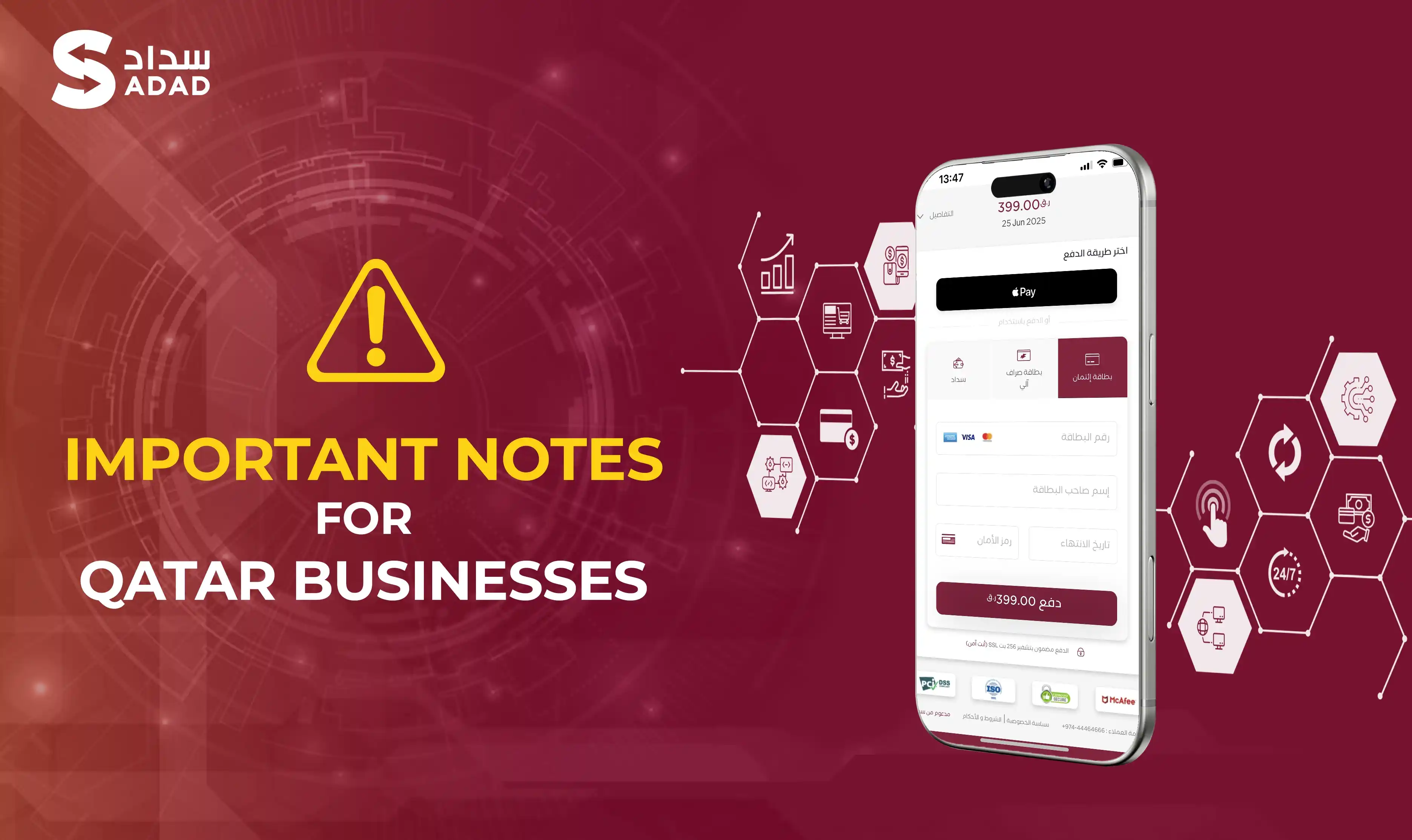
Five trends, one common thread: they all reward businesses that run on connected infrastructure and punish those still stitching together separate tools for POS, online checkout, invoicing, and reconciliation.
The merchants I see struggling most in Qatar’s shifting payment landscape aren’t the ones who haven’t gone digital. Most have. The problem is they’ve gone digital in pieces: one provider for in-store, another for online, a spreadsheet for reconciliation. That fragmentation gets more expensive as payment channels multiply.
The practical move right now is consolidation, not addition.
Before activating wallet acceptance or cross-border payment methods, make sure your foundation is solid: a single platform that connects every channel, settles locally through NAPS, and provides real-time visibility across all transactions in a single dashboard.
That’s not a future state. It’s available today.
SADAD was built as Qatar’s first independent fintech with direct access to NAPS and QPay, enabling faster settlement, fewer intermediaries, and full alignment with the QCB’s infrastructure.
The businesses that position correctly now won’t need to scramble when the next wave arrives. They’ll already be running on the right rails.
If you still have questions about what any of this means in practice, the answers below cover what we hear most from merchants navigating this shift.
Frequently Asked Questions About the Future of Payments in Qatar
Is Qatar moving toward a cashless economy?
In practice, yes. 96% of in-store transactions in Qatar are now contactless, and the QCB has stated its goal of a cash-light economy by 2030. Cash isn’t disappearing overnight, but its role is narrowing every quarter, and the infrastructure being built isn’t designed to bring it back.
What is Fawran, and should my business accept it?
Fawran is Qatar’s instant account-to-account payment system, operating 24/7. Right now, it’s strongest for P2P transfers and bill payments, but it’s expanding into B2B settlements. Businesses that can receive and reconcile Fawran transfers will have a cash flow advantage over those still waiting on batch settlements.
What’s the difference between QMP and Fawran?
Fawran moves money directly between bank accounts in real time. QMP is the wallet ecosystem app consumers load with funds and use to pay at checkout. Both are growing, and both serve different moments in the customer journey. Understanding how e-wallets work is a practical starting point for any merchant evaluating which to prioritize first.
What payment solution makes the most sense for a small business in Qatar today?
Look for a QCB-licensed platform with direct NAPS connection, SoftPOS capability, online payment links, and a single dashboard for reconciliation. Juggling multiple providers for each of these creates more work, not less. The goal is one system that covers every channel your customers actually use. That’s exactly what SADAD is built to do.
The answers point in one direction, and so does everything else happening in Qatar’s payment ecosystem right now.
The Future of Payments in Qatar Is Already Here. Are You Ready for It?
The five trends covered in this article aren’t predictions. Fawran is live. SoftPOS is active. Wallet adoption is accelerating. The Mastercard Gateway integration is running.
The QCB’s 2030 strategy is already reshaping the rails beneath every transaction processed in Qatar today.
What changes between now and 2030 isn’t whether these shifts happen, it’s which businesses are positioned to benefit from them and which are still catching up.
The merchants who move early on a unified, locally connected payment infrastructure will carry a real advantage into that period. Those who wait will spend the next few years reacting rather than growing.
If you’re ready to run your payments on infrastructure built for where Qatar is heading, not where it’s been, get started with SADAD today. Your account goes live in under an hour.
Last Articles
Articles
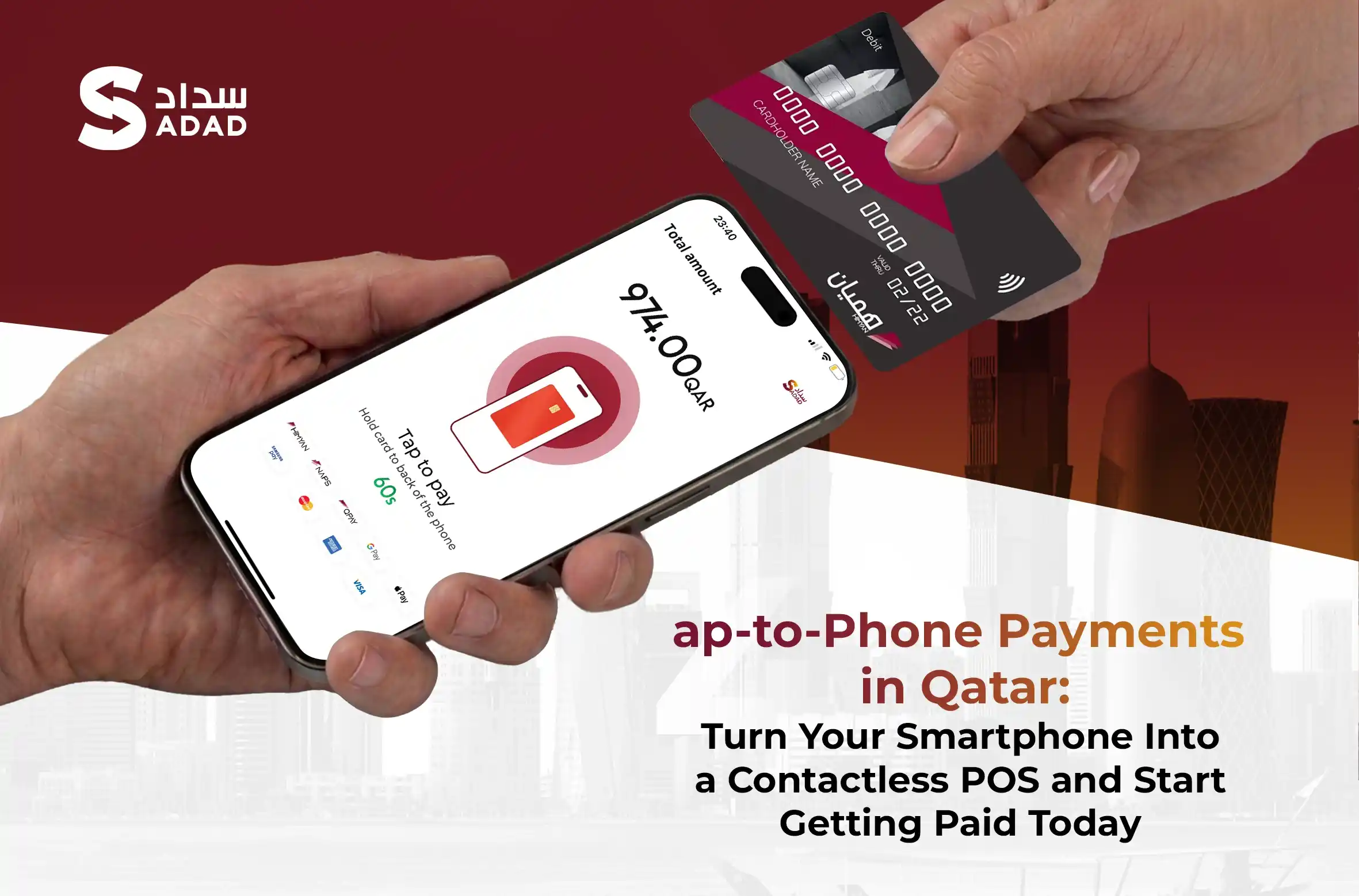
Your Phone Is a POS Terminal Now: The Complete Guide to Tap-to-Phone Payments in Qatar
Tap-to-Phone Payments in Qatar: Turn Your Phone Into a POS Terminal and Start Getting Paid Today Your customers are already tapping to pay. The real question is whether your business...
Read more
Articles
The Qatar Business Owner’s Guide to WhatsApp Commerce and Getting Paid Faster
WhatsApp Commerce in Qatar: How to Turn Conversations into Sales with Payment Links You have already made sales on WhatsApp without calling them sales. A customer messages you asking about...
Read more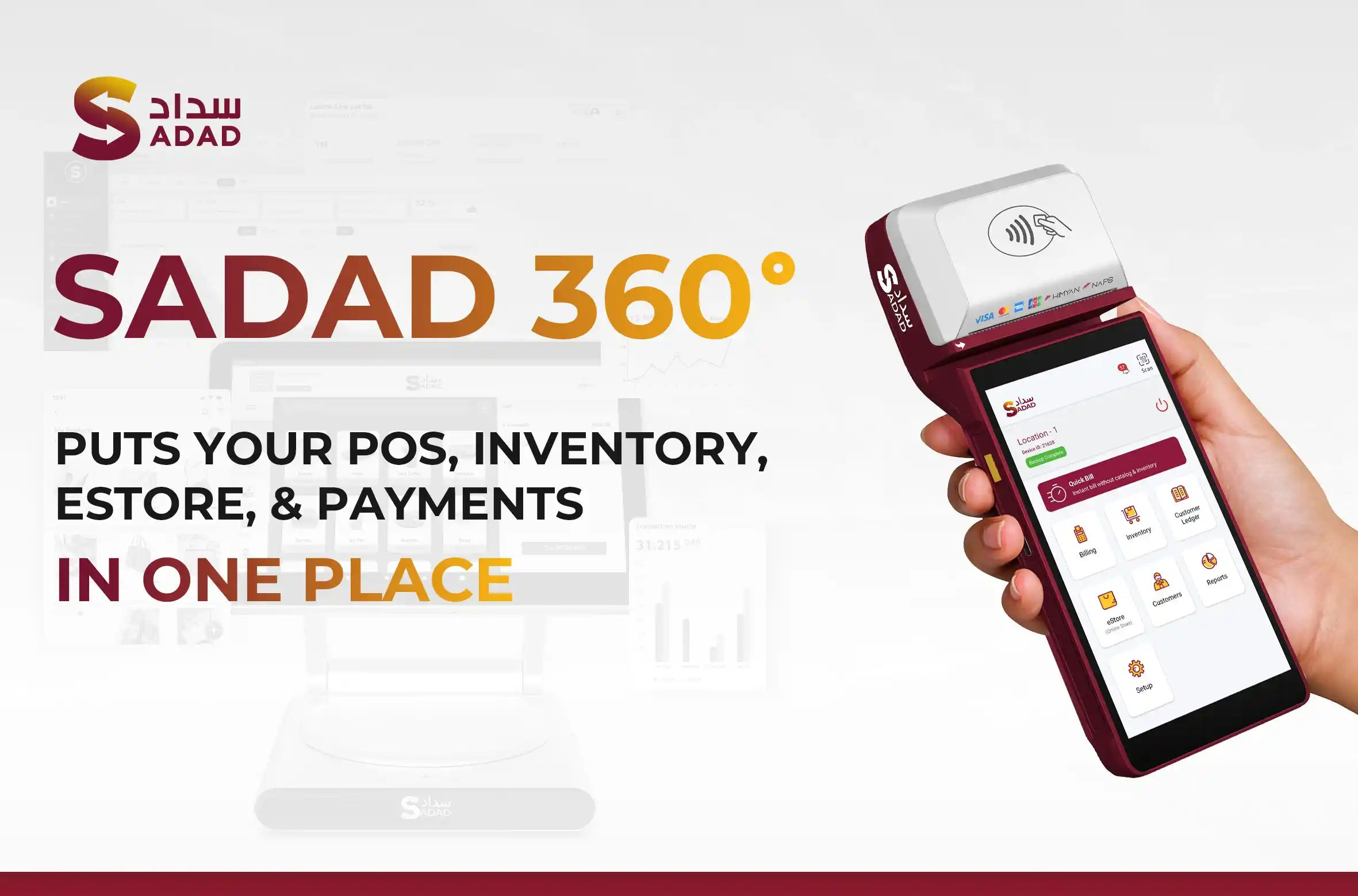
Articles
SADAD 360: The All-in-One Business Suite Built for Qatar’s SMEs
SADAD 360: The All-in-One Business Suite Built for Qatar's SMEs Most businesses in Qatar aren't struggling because of bad products or poor service. They're struggling because they're running their operations...
Read more