
Articles
From Invoice to Payment: How Companies Are Digitizing Their Entire Collection Process
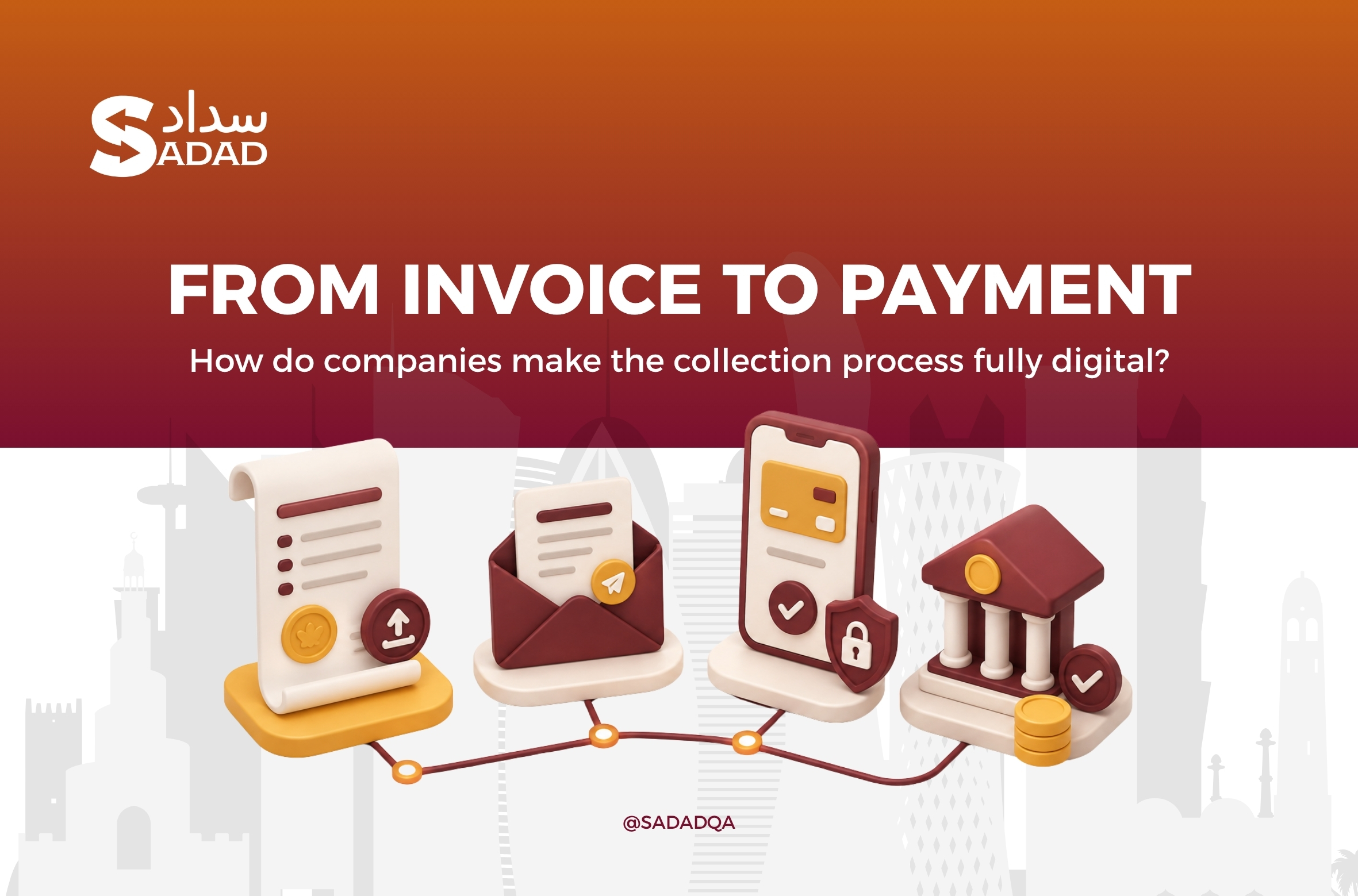
Lost paper invoices, cluttered filing cabinets, complex transactional routines, and recurring human errors during manual entry—these are all real-world challenges that businesses struggled with prior to digitizing their collections.
Today, businesses are in a race toward greater efficiency, speed, and operational excellence. Providing an excellent service or a high-quality product is no longer enough to sustain long-term growth. Cash flow is the lifeblood of every business, yet traditional approaches to invoicing and payment collection can create significant obstacles, including delayed cash flow, increased errors, and higher operating costs. From this perspective, digitizing the entire payment collection process—from issuing an invoice to receiving the payment—has become an indispensable strategic necessity.
This transformation aligns directly with the State of Qatar’s national vision to build a fully digital, paperless economy. It reflects the strategic directives of the Qatar Central Bank (QCB), which considers digital transformation and a paperless financial ecosystem as core pillars to advance the national financial sector and fulfill Qatar National Vision 2030.
Moving to digital invoicing extends far beyond abandoning paper; it represents a fundamental redefinition of how corporate finances are managed. Instead of relying on
complex collection cycles, invoices can be issued and delivered instantly, customers can pay through flexible digital payment options, and transaction data can be automatically integrated into accounting systems.
The result is faster cash flow, lower operating costs, fewer manual processes, and a smoother, more reliable customer experience.
What Are Paperless Transactions in Business?
Paperless transactions refer to the conversion of business, financial, and administrative documents and processes from traditional printed formats into secure and efficient digital formats.
In financial collection specifically, this means completely eliminating the need for printed invoices, paper checks, manual records, and physical documentation. Instead, an invoice is generated digitally and delivered to the customer through convenient channels such as email, SMS, or WhatsApp. The customer can then pay securely using a variety of online payment methods. Once the payment is completed, the transaction is automatically recorded and stored in secure digital or cloud-based financial systems—without printing a single sheet of paper. This creates a connected digital process in which invoicing, payment, reconciliation, reporting, and recordkeeping become part of one streamlined workflow.
From Manual Tracking to Digital Automation: Why Are Businesses Digitizing Collection Processes?
As businesses grow and regulatory requirements become increasingly complex, traditional collection methods—such as manual reminders, spreadsheets, emails, and disconnected tracking systems—are no longer sufficient to keep up with the speed of modern commerce.
Businesses now need to manage invoices, payment collection, financial approvals, and reconciliation with greater speed and accuracy. This has shifted the focus from basic manual tracking tools toward integrated digital payment solutions and online payment gateways such as SADAD.
Payment collection is also no longer limited to the local market. As businesses expand regionally and internationally, they increasingly require digital collection solutions capable of accepting payments through a broad range of local and international payment methods and currencies.
A modern digital payment infrastructure allows businesses to turn invoices into actual cash flow more efficiently while providing customers with a convenient and secure way to pay.
Structural Challenges in Traditional Collection Methods
Across industries, businesses continue to experience similar operational challenges when payment collection depends on disconnected and manual processes:
-
Slower Workflows: Manually preparing invoices and financial documents slows down finance teams and extends the overall collection cycle.
-
Approval Bottlenecks: Financial approvals and settlement processes can become trapped in long email chains and complicated approval workflows, delaying transaction completion.
-
Data Dispersal & Version Conflicts: Storing contracts and documents across disconnected systems leads to data inconsistencies over time.
-
Compliance Risks: Financial and regulatory compliance grows increasingly difficult without unified digital documentation.
-
Limited Visibility: Finance and collection teams lack real-time visibility into outstanding invoices, overdue payments, daily collections, and the overall cash-flow position of the business.
Strategic Drivers for Adopting Digital Collections
Businesses are moving toward digital collection solutions for several strategic reasons:
-
Accelerating Cash Flow and Reducing DSO: Automation significantly shortens the time between issuing an invoice and receiving payment. Reducing Days Sales Outstanding (DSO) helps businesses improve liquidity and maintain healthier cash flow.
-
Reducing Bad Debt: Automated payment reminders and simple digital payment experiences encourage customers to pay on time, reducing the risk of overdue balances and bad debt.
-
Eliminating Human Errors and Repetitive Tasks: Automation reduces the risks associated with manual data entry, duplicate invoices, misplaced documents, and repetitive administrative work.
-
Improving Financial Visibility: A centralized dashboard provides real-time visibility into collections, outstanding invoices, completed payments, and daily or monthly revenue, enabling finance teams to make better-informed decisions.
-
Supporting Cross-Border Payments: Modern payment gateways support a wide range of local and international payment methods, helping businesses serve customers across different markets and simplify cross-border collections.
-
Adapting to Changing Customer Payment Preferences: Customers increasingly expect fast, convenient, and mobile-friendly payment experiences. Payment links, digital wallets, cards, and mobile payment options provide a convenient alternative to traditional checks and paper-based transactions.
-
Supporting Sustainability and ESG Goals: Reducing paper invoices, printed receipts, physical documents, and manual transportation helps businesses reduce their environmental footprint and support broader sustainability initiatives.
How Does Online Payment Collection Increase Collection Speed?
Collection speed is not about pressuring customers; it is about building an obstacle-free path between service delivery and fund settlement. The primary reason customers delay payment is rarely an inability to pay, but rather friction within the payment process itself. Forcing a customer to hunt for bank details, write physical checks, or call for payment instructions creates unnecessary delays.
Digital collections eliminate this friction, transforming a slow administrative task into an effortless, one-click experience through the following mechanisms:
-
Minimizing Payment Friction: A direct Payment Link embedded in an invoice allows customers to pay immediately using their preferred payment method without searching for bank details or calling for payment instructions.
-
Compressing the Time-to-Payment Window: Invoices reach the customer instantly upon issuance, enabling immediate settlement and dramatically shortening the billing-to-cash cycle.
-
Automated Reminders: Scheduled notification sequences alert customers prior to and on due dates, reducing reliance on manual follow-ups and preventing late payments.
-
Instant Reconciliation: Payments are automatically matched to corresponding invoice numbers upon completion, cutting down hours spent on manual bank reconciliation.
-
Continuous Pipeline Visibility: Clear visual tracking highlights pending versus overdue invoices, empowering finance teams to prioritize critical follow-ups.
-
Seamless ERP & System Integration: Connecting billing engines directly with CRM, inventory, and accounting software automates data transfers and prevents cross-departmental errors.
-
Enhanced Customer Experience: A clear, unified invoice and payment interface removes friction points that lead to intentional payment deferrals.
How Do Digital Solutions Reduce Paper-Based Transactions?
A fully digital collection process eliminates the need for paper by transforming every stage of the payment journey into a secure digital data point within an integrated environment.
Instead of relying on traditional document cycles involving printing, physical delivery, manual filing, and storage, digital platforms automate the financial process from the moment an invoice is created through to payment and reconciliation.
Digital tools contribute to reducing paper-based transactions in several important ways:
-
Interactive e-Invoicing: Replaces physical invoice books with customizable digital templates generated at the click of a button.
-
Instant Digital Dispatch: Payment links are delivered straight to customer devices via email, SMS, or WhatsApp, bypassing physical mail delivery entirely.
-
Direct Digital Settlement: Customers settle balances immediately via debit/credit cards or digital wallets, bypassing paper checks and physical receipts.
-
Automated ERP Integration: Payment gateways feed transaction statuses directly into core financial software, updating invoice states in real time.
-
Cloud Archiving & e-Signatures: Financial records, contracts, and approvals are stored in secure cloud environments, eliminating the need for printing or scanning.
From Invoice Issuance to Payment Collection: How Can Businesses Go Fully Digital with SADAD?
SADAD Payment Solutions is a pioneer in shaping Qatar’s digital financial landscape, actively supporting the digital economy objectives under Qatar National Vision 2030.
SADAD is positioned as a leading electronic payment solutions provider in Qatar, supporting businesses in their transition toward more efficient and digitally enabled payment and collection processes. Its solutions are designed to help businesses move away from paper-based workflows and manage invoicing, payment collection, transaction tracking, and financial operations digitally.
The digital journey begins with registration and continues through invoicing, payment, confirmation, reconciliation, and reporting—all through connected digital tools.
SADAD stands out as the first entity licensed and regulated by the Qatar Central Bank (QCB), having pioneered the digital payment sector in Qatar since 2018. Beyond local accreditation, SADAD is officially certified by global card schemes (Visa and Mastercard) and holds the distinction of being the first company in the Middle East certified by Microsoft for cloud data security. These credentials position SADAD as a trusted partner for enterprises transitioning away from paper-based operations.
A Completely Digital Onboarding and Collection Journey
Signing up with SADAD is designed to be 100% paperless, requiring no physical documentation or branch visits:
-
Open to All Business Sectors: Supports standard Commercial Registrations (CR), e-CRs, home-based business licenses, and government entities.
-
Dedicated Mobile Management (SADAD QA Business): Merchants can download the SADAD QA Business app to initiate corporate registration immediately.
-
Paperless Onboarding & Verification: Complete registration by uploading documents and executing e-signatures directly through the mobile interface to activate services such as Invoice Payment Links, Payment Gateways, or Mawedy (My Appointment).
-
One-Click Invoice Generation: Create detailed line-item invoices or quick payment links by inputting the customer’s phone number, email, description, and amount.
-
Multi-Channel Link Sharing: Share direct payment links or invoices through email, SMS, or WhatsApp.
-
Multi-Currency & Comprehensive Card Acceptance: Clients select their preferred payment channel—including NAPS, Visa, Mastercard, AMEX, Mada, Apple Pay, Google Pay, and the SADAD Wallet—all secured under PCI-DSS Level 1 compliance.
-
Real-Time Settlement Notifications: Immediate payment confirmation alerts both merchant and customer, updating invoice status to “Paid” automatically.
-
Comprehensive Financial Control (SADAD Cloud & Business App): Manage corporate accounts through a unified portal to resend invoices, track real-time transactions, generate detailed financial reports, and execute bank settlements.
How to Begin Your Company’s Digital Collection Journey
Transitioning to digital collections does not require massive capital investment. It relies on a structured transition from manual workflows to an integrated ecosystem connecting invoicing, payments, tracking, and reporting:
-
Audit Current Collection Workflows: Map out your current document lifecycle, calculate your average Days Sales Outstanding (DSO), and identify manual bottlenecks (e.g., delivery delays or slow bank reconciliation).
-
Set Measurable Transformation Goals: Establish concrete operational targets, such as reducing average collection times, decreasing overdue balances, and reducing manual accounting hours.
-
Select the Right Financial Infrastructure Partner: Choose a robust gateway platform like SADAD that offers top-tier security standards (PCI-DSS), broad payment acceptance (NAPS, Apple Pay, multi-currency), and seamless API/ERP integration capabilities (e.g., SAP, Oracle, QuickBooks, Zoho).
-
Automate Invoicing & Payment Links: Swap paper receipt books for interactive e-invoices and enable automated payment link sharing via SMS, email, and WhatsApp to allow instant one-click settlements.
-
Implement Automated Payment Reminders: Configure automated notification schedules to alert customers prior to and after due dates, keeping collection pipelines clean without consuming staff hours.
-
Train Teams and Inform Customers: Onboard finance teams to leverage cloud analytics dashboards and notify your client base about the speed, convenience, and security of new digital payment options.
-
Scale Gradually: Roll out digital collections to a targeted client segment first to validate system workflows and ERP integrations before expanding across all corporate divisions.
Time to Collect Your Receivables Faster
Every day payments are delayed translates to wasted administrative hours, manual overhead, and unnecessary cash flow pressure.
Transform your collection process from a passive waiting game into an automated, high-speed digital experience.
With SADAD, make payments simpler and collections faster.
👉 [Start Automating Your Collections Today with SADAD]
آخر مقال
المقالات
From Invoice to Payment: How Companies Are Digitizing Their Entire Collection Process
Lost paper invoices, cluttered filing cabinets, complex transactional routines, and recurring human errors during manual entry—these are all real-world challenges that businesses struggled with prior to digitizing their collections. Today,...
اقرأ المزيد
المقالات
من الفاتورة إلى الدفع: كيف تجعل الشركات عملية التحصيل رقمية بالكامل؟
ضياع الفواتير الورقية، تكديس الملفات والمستندات، المشاوير المعقدة لإتمام المعاملات، والأخطاء البشرية المتكررة أثناء الإدخال اليدوي... جميعها مشاكل واقعية عانت منها الشركات طويلاً قبل رقمنة عمليات التحصيل. اليوم، تخوض الشركات...
اقرأ المزيد
المقالات
أفضل مِنصَّات الدفع الإلكتروني في قطر: مقارنة عملية لاختيار بوَّابة الدفع المناسبة
مِنصَّات الدفع الإلكتروني في قطر: كيف تختار بوَّابة الدفع الأنسب لنمو مبيعاتك؟ الخطأ الذي يقع فيه كثير من التجار في قطر أنَّهم يختارون مِنصَّة الدفع كما لو كانوا يشترون أداة...
اقرأ المزيد