
Articles
Pricing of POS Software in Qatar: What Every Business Should Know Before Signing Up
Pricing of POS Software in Qatar: What Every Business Should Know Before Signing Up
TL;DR: The Key Takeaways if You’re Short on Time
- POS software pricing in Qatar consists of three components: a one-time setup fee, a monthly device subscription, and a transaction commission on every sale.
- Banks often skip the first two but charge less on the third, which sounds like a deal until you realize invoicing, online payments, reporting, and support all require separate systems and separate contracts.
- SADAD publishes all its pricing openly and runs everything through a single platform licensed by the Qatar Central Bank.
- Local NAPS card transactions cost you 1.1%. SoftPOS has no upfront cost. The Payment Gateway starts at 99 QAR per month.
- The annual plan for all online services saves you 20%.
- The rest of this article shows you exactly how those numbers translate to your business type.
Most businesses in Qatar don’t choose their POS software. They inherit it.
A bank rep shows up, sets up a terminal, quotes a rate, and that’s the end of the conversation. No one explains what POS software pricing in Qatar actually looks like. No one breaks down the three cost layers you’re agreeing to.
And no one tells you what happens when you need support, want to accept a new payment method, or try to understand your monthly statement.
Here’s what that conversation should have included.
This article breaks down how POS software pricing in Qatar actually works, including the setup fees, the monthly costs, and the transaction commissions, and shows you exactly what SADAD charges across every layer. So, you can stop guessing and start comparing.
Three Numbers. That’s All Your POS Cost Really Is.
Pricing of POS Software in Qatar
Most businesses shopping for a POS device in Qatar do the same thing: they ask about the rate, hear a percentage, and make a decision based on that one number.
That’s where the confusion starts.
POS software pricing in Qatar comprises three distinct cost layers, and if you look at only one, you’re working with an incomplete picture.
The first is the setup fee
A one-time charge you pay to activate your account and get your device configured. Some providers skip this entirely. Others charge several hundred riyals upfront.
The second is the monthly device rental
An ongoing subscription that covers your use of the physical terminal. This one trips people up because banks have largely stopped charging it.
Payment solution companies still do, and for good reason: it funds the support, maintenance, and infrastructure behind the device.
The transaction commission
Every time a customer pays, a small percentage is deducted from that sale. The rate varies depending on which card they use, not which rate you negotiated. A customer tapping a local NAPS card pays a different rate than one paying with an Amex.
Qatar Central Bank requires all licensed payment providers to publicly publish these three components.
SADAD does exactly that, with full pricing listed openly on their pricing page, no sales call required just to find out what you’ll pay.
Once you see all three numbers together, the real cost of any POS setup becomes a lot clearer.
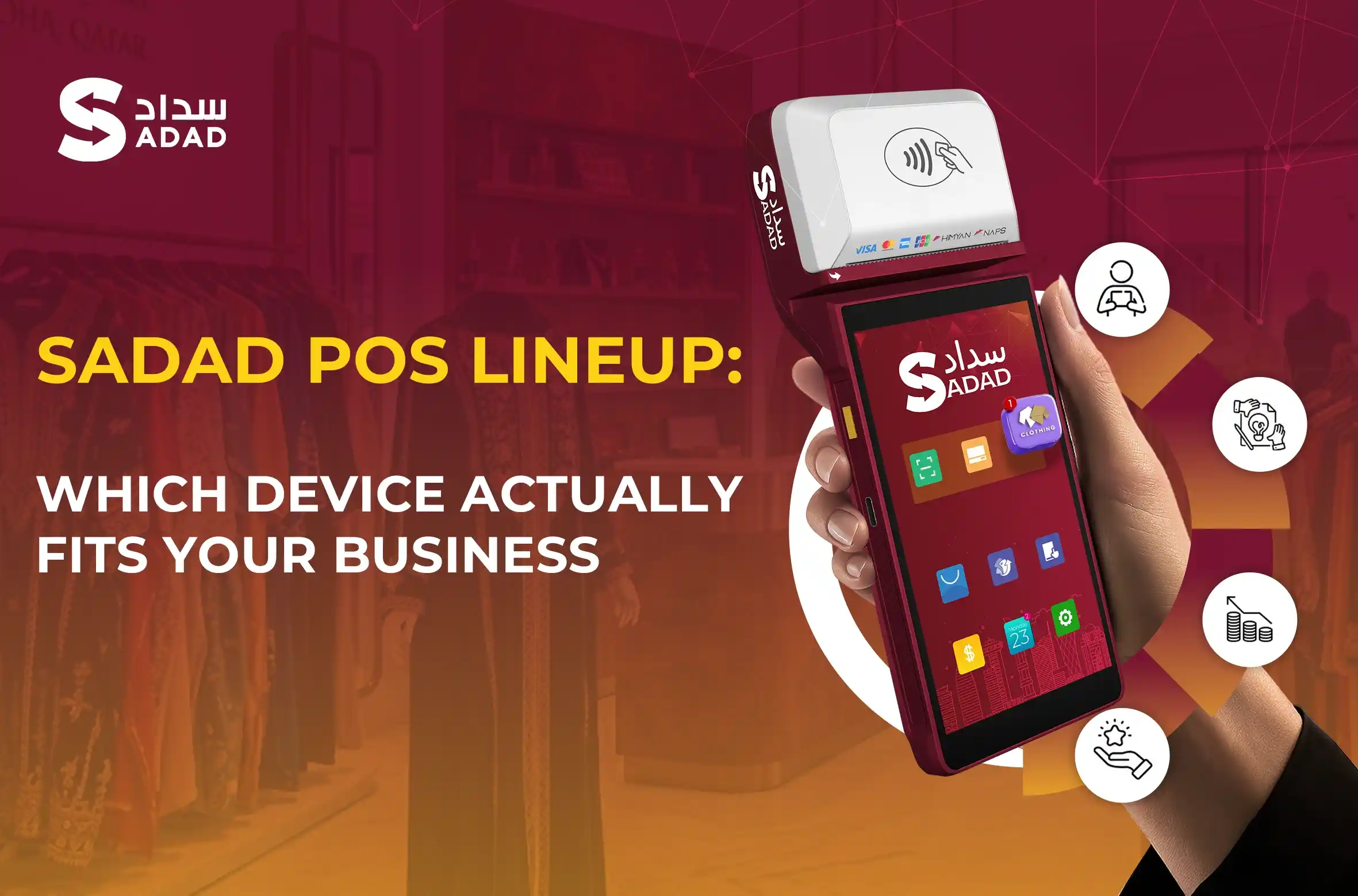
The SADAD POS Lineup: Which Device Actually Fits Your Business
Now that you know what the three cost layers look like, the next question is which SADAD setup makes sense for how you actually operate.
There are three options, each solving a very different problem.
SADAD Plus is the full smart POS device built for businesses with a fixed counter. A café in The Pearl, a boutique in Villaggio, a clinic in West Bay.
You pay a one-time 399 QAR setup fee, a 1,000 QAR refundable deposit returned after six months, and a monthly device subscription. It prints receipts, accepts all card types, and runs through a single merchant dashboard.
SADAD Self follows the same pricing structure. It’s designed for businesses that want a more self-managed or kiosk-style setup, think service counters, shared workspaces, or multi-staff environments, where you want the hardware without a lot of hand-holding.
Then there’s SADAD SoftPOS, which changes the math entirely. No device to buy. No setup fee. No monthly hardware rental.
You download the app to an NFC-enabled Android phone, and it becomes the terminal. For delivery drivers, freelancers, pop-up vendors, and home-based businesses in Qatar, this removes the biggest objection to going cashless: the upfront cost.
Here’s the thing most providers won’t tell you: The right device isn’t the cheapest one.
It’s the one that matches how your customers actually pay and where your team actually works.
A delivery business running on a traditional POS terminal is paying for hardware it barely uses. A retail shop relying solely on SoftPOS might encounter friction during peak hours.
Start with the workflow. Then pick the device.
Transaction Fees What You’re Actually Paying Per Sale (and Where the Money Goes)
This is the layer that quietly adds up every single day, and most business owners in Qatar have never stopped to think about how it actually works.
When a customer pays you 500 QAR, SADAD doesn’t pocket a fixed cut. The rate that applies depends entirely on which card your customer uses at checkout, not the agreement you signed.
A local NAPS debit card costs you 1.1% on that transaction. A local Visa or Mastercard credit card incurs a 2.2% fee plus 0.5 QAR.
Apple Pay and Google Pay fall under the same rate as Visa and Mastercard. Co-branded business cards come in at 2.5%, and international cards like Amex sit at 3%.
On that 500 QAR sale, the deduction ranges from 7.5 QAR on a NAPS tap to 15 QAR on an Amex. Refunds cost you nothing.
Here’s what most providers don’t bother explaining: of that percentage deducted, the majority flows directly to Visa, Mastercard, or whichever card network processed the transaction. SADAD keeps a portion, but it’s not the whole rate.
The card networks set their own interchange fees, and every payment processor in Qatar, including banks, passes them on. It’s not a SADAD markup. It’s the cost of the global card infrastructure.
What SADAD brings on top of that is a full-stack platform licensed by the Qatar Central Bank, with direct access to NAPS and principal membership with Visa and Mastercard, which means better approval rates and fewer failed transactions.
For startups and home-based businesses with lower volumes, SADAD’s team can discuss arrangements that fit your stage. The published rates are the standard, but they’re worth a conversation if you’re just getting started.
Selling Online in Qatar? Here’s What SADAD Charges, and What It Doesn’t
Most of the noise around payment pricing focuses on physical terminals.
But if you’re running an online store, collecting payments through WhatsApp, or sending invoices to clients, the cost structure looks completely different.
And in most ways, it’s more straightforward.
With SADAD’s online payment solutions, there are no setup fees. No registration charges. No maintenance costs buried in the fine print. Support is included around the clock. You’re not paying a subscription just to exist on the platform. You pay when you actually process money.
The transaction rates for online payments sit at 2.5% across most card types, local NAPS cards, Visa, Mastercard, wallets, and co-branded cards. International cards like Amex carry a 3% fee. There’s a minimum charge of 2.5 QAR per successful transaction, and online refunds cost 2 QAR.
That minimum is worth paying attention to. If your average transaction is a 20 QAR coffee or a small service booking, the 2.5 QAR floor changes your effective rate. If your average order is 400 QAR, it barely registers.
What makes this worth understanding is the zero-cost entry point. A small business in Qatar can start accepting online payments through payment links or invoices without paying a single riyal upfront. Send a link, customer pays, money lands in your account. No terminal. No setup. No waiting.
That’s a meaningful shift from how most businesses here have been operating, and it’s one of the more underused tools available to anyone collecting money in Qatar right now.
SADAD’s Online Tools: What You Pay Monthly (and Where the Annual Plan Earns Its Keep)
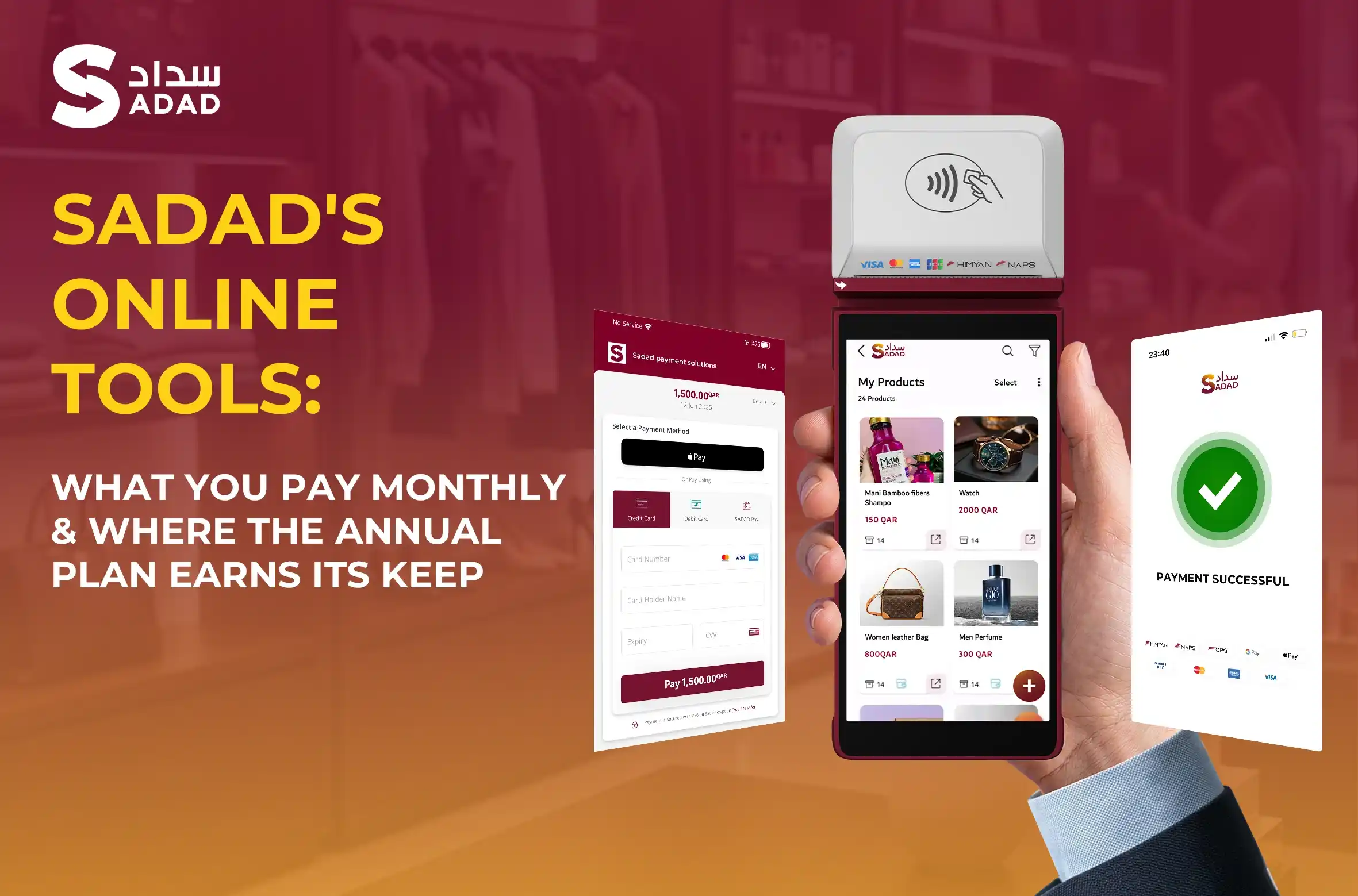
If you’re doing anything beyond in-person payments, collecting payments through your website, sending invoices to clients, or running a small online store, SADAD has a set of tools built for those needs. And the pricing here works differently from the device side.
The Payment Gateway starts at 99 QAR per month for the standard API integration. If you need a hosted web checkout, that’s 149 QAR per month.
A direct payment API that gives you the deepest level of control over the checkout experience costs 199 QAR per month. All three come with a 20% discount if you commit to an annual plan.
Invoices and payment links to Qatari numbers are free. International links run 99 QAR per month, also with a 20% annual discount.
The Smart Store, where you can list your products and share a link with customers, is free up to 25 products, then 99 QAR per month after that. A customized branded checkout page is 99 QAR per month.
Here’s where the annual plan becomes an actual decision worth making. At 199 QAR per month, switching to annual saves you roughly 478 QAR per year.
On the 99 QAR plan, it’s about 238 QAR back in your pocket. That’s not transformative money, but it’s real money for what amounts to a choice about how you pay.
The more interesting thing is how these tools layer together.
A business running invoices, a smart store, and a payment gateway through SADAD is operating on one merchant dashboard, one support line, and one reconciliation view.
That consolidation matters more than most businesses realize until they’ve tried managing it across separate platforms.
What SADAD Actually Costs per Month: Three Business Types, Real Numbers
Pricing pages show you rates. This section shows you what those rates actually look like in practice, depending on how you operate.
Scenario one: the mobile or home-based seller.
You’re running a service, selling at pop-up markets, or taking payments on delivery. You set up SADAD SoftPOS on your Android phone.
No device fee, no monthly subscription. If you process 10,000 QAR in a month through local debit cards, you’re paying around 150 QAR in transaction fees.
That’s it. For businesses just starting to reduce their reliance on cash, this is probably the lowest-friction entry point in Qatar.
Scenario two: the small retail shop.
You have a counter, a fixed location, and staff handling transactions through the day.
You’re on SADAD Plus. Your monthly cost is the device subscription plus any fees generated by your transaction volume.
If you’re doing 50,000 QAR in monthly sales, mostly local cards, you’re looking at somewhere around 750 QAR in transaction commissions on top of the subscription.
The pricing is structured around your business size, and if your numbers look different, SADAD’s team is worth talking to directly.
Scenario three: the growing business running online and in-person.
You’re on SADAD Plus for the physical side and the Payment Gateway API at 99 QAR per month for online.
You’re collecting through payment links, running a smart store, and reconciling everything through one dashboard. Your monthly fixed cost is predictable.
Your variable cost scales with sales. And you’re not managing three different platforms or chasing three different support teams when something breaks.
That last part is where the full-stack payment approach tends to pay for itself.
Why Banks Look Cheaper on Paper, and Cost More in Practice
Let’s address the thing you’re probably thinking.
Banks offer lower transaction rates. That’s true. If you walk into a bank in Qatar and ask for a POS terminal, the rate they quote for local cards is often lower than SADAD’s charges. So why would anyone choose SADAD?
Because a rate is not a cost.
When a bank gives you a terminal, you’re getting one thing: a device that processes card payments.
Everything else, including invoicing, payment links, online checkout, real-time reporting, and e-commerce integration, requires a separate provider, contract, and support relationship. Add those up across a year, and the “cheaper” rate starts to look different.
There’s also the service reality.
Banks in Qatar are not payment technology companies. Their POS offering is a side product.
When something breaks or a customer has a payment dispute, you’re navigating a system that wasn’t designed with your daily operations in mind.
SADAD is built as a complete payment platform, licensed by the Qatar Central Bank, directly connected to NAPS, a principal member of Visa and Mastercard, and compliant with both PCI-DSS and ISO 27001. That’s not marketing copy.
Those are security and compliance standards that determine whether your transactions are reliably approved and whether your customer data is properly protected.
The businesses that switch to SADAD after a bank setup rarely do it because of the rate.
They do it because they got tired of managing four different systems, or because a payment failed at the wrong moment, and they had no one local to call.
A lower rate on one cost layer doesn’t matter much if the other layers are eating your time and your operations.
Final Words
The terminal your bank gave you came with a rate. It didn’t come with the full breakdown, and it definitely didn’t come with a platform built around how businesses in Qatar actually operate.
SADAD does.
One place to accept payments in person, online, through invoices, and via payment links. One dashboard to track everything.
One local team, when you need support, no ticket queues, no overseas call centers, no waiting until Monday.
If you’re a retailer, a freelancer, a delivery business, or a growing operation trying to get your payments under control, the conversation starts at SADAD.
And if you’re still figuring out which setup fits your business, whether that’s a physical POS device, SoftPOS on your phone, or a full online payment stack, SADAD’s team can walk you through the numbers based on your actual volume and how you work.
No pressure. Just a clearer picture of what you’ll actually pay, and what you’ll actually get.
read more :QCB: POS and e-Commerce Transactions Hit QR13.8 Billion in March 2025
Last Articles
Articles
Shipping in Qatar via Sadad in Partnership with Qatar Post 2026 | Door-to-Door Shipping
Shipping in Qatar via Sadad in Partnership with Qatar Post | Door-to-Door Shipping Shipping in Qatar has traditionally been associated with Qatar Post and a specific range of delivery services....
Read more
Articles
POS Machine Prices and Types in Qatar 2026 | Comprehensive Guide for Businesses and Restaurants
Comprehensive Guide to POS Machine Prices and Types in Qatar for Businesses and Restaurants In Doha's fast-moving business environment, where new cafés, fine-dining restaurants, retail stores, and service businesses continue...
Read more
Articles
How to Start Online Business in Qatar: Your Complete 3-Step Guide (License, Store, and Profits)
How to Start Online Business in Qatar? In the heart of Doha, with every screen tap and smartphone glow, a new economic landscape is taking shape. Success is no longer...
Read more