
Articles
Your Phone Is a POS Terminal Now: The Complete Guide to Tap-to-Phone Payments in Qatar
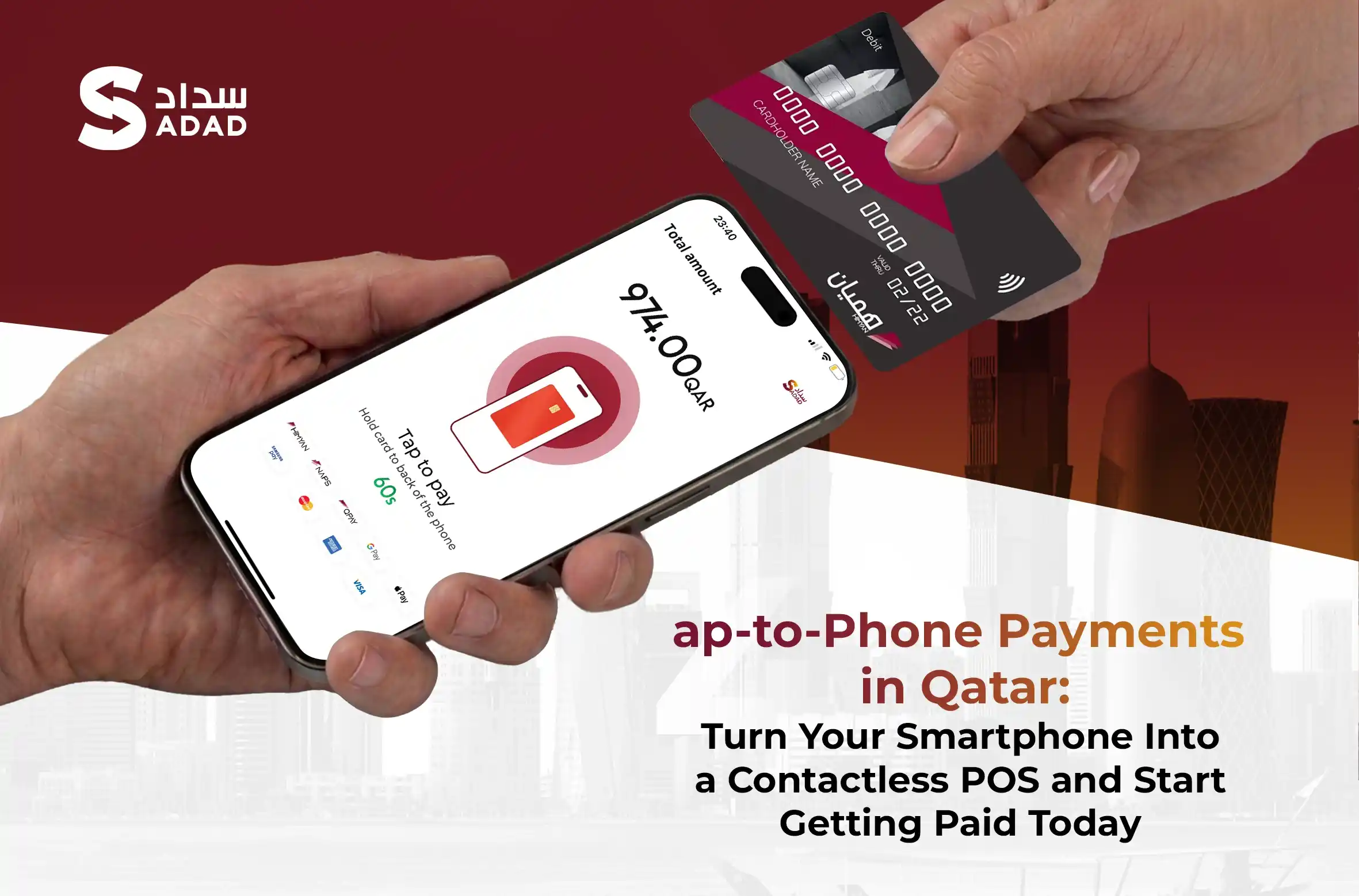
Tap-to-Phone Payments in Qatar: Turn Your Phone Into a POS Terminal and Start Getting Paid Today
Your customers are already tapping to pay. The real question is whether your business is set up to receive it.
In July 2025 alone, Qatari businesses processed $4.4 billion in digital transactions across 51.7 million individual payments. That’s not annual revenue. That’s one month. And point-of-sale transactions led the pack at $2.25 billion from over 40 million in-person payments.
40 million taps. In 31 days. In a country of 3 million people.
Meanwhile, thousands of small businesses in Qatar are still waiting two weeks for a POS terminal to arrive, paying setup fees for hardware that breaks, or losing sales because their card machine won’t accept Apple Pay. The problem isn’t that customers don’t want to pay digitally. Visa’s own research found that 80% of merchants in Qatar have seen their revenues increase after accepting digital payments. The problem is the hardware gap between what customers expect and what most small businesses can actually afford to set up.
Tap-to-phone payments close that gap completely.
Visa’s Tap to Phone grew 341% year over year in Qatar, more than double the global 200% adoption rate.
Over 95% of Qatar’s 25,000 registered private-sector businesses are SMEs, and most can’t absorb the cost, delays, or complexity of a traditional POS rollout. Tap-to-phone was built for exactly this segment.
Your existing smartphone becomes the terminal. No hardware purchase. No waiting on delivery. No setup fees. Just download an app and start accepting cards, Apple Pay, Google Pay, and NAPS payments on the spot.
This guide breaks down how it works, what it costs, who it’s right for, and how to get started in Qatar today.
What Tap-to-Phone Payments Actually Are (And Why the Name Explains Everything)
Tap-to-phone turns your existing smartphone into a payment terminal. The customer taps their card, phone, or watch against your device, and the payment goes through. That’s it.
No card reader. No dongle. No hardware purchase.
The technical term is SoftPOS, short for Software Point of Sale.
Instead of relying on dedicated payment hardware, SoftPOS uses the NFC antenna already built into your smartphone to read payment data from a customer’s card, phone, or wearable. The phone becomes the reader.
Here’s what actually happens at checkout, in plain terms:
- You open the app and enter the amount
- The customer taps their contactless card, phone, or smartwatch against your device
- The NFC chip reads a one-time encrypted token, never the actual card number
- The transaction routes through Visa, Mastercard, or NAPS, exactly like a traditional terminal would
- Approved. Digital receipt sent by SMS or email. Done.
The whole flow takes 1 to 2 seconds. No PIN fumbling, no waiting for a card reader to connect via Bluetooth, no “sorry, machine’s not working.”
One thing worth clarifying: NFC is not the same as tap-to-phone. NFC is the underlying wireless technology. Tap-to-phone is the merchant-side software that uses NFC to accept payments.
Your customers have been using NFC every time they tap their card anywhere. You’re now just on the receiving end of that same signal.
The naming gets messy because each network branded it differently. Visa calls it Tap to Phone, Mastercard calls it Tap on Phone, and Apple calls it Tap to Pay.
Same technology. Different labels. If you want to dig deeper into what payment solutions actually are and how they work in Qatar, the concept extends well beyond just the phone.
How to Set Up Tap-to-Phone Payments in Qatar: What You Actually Need
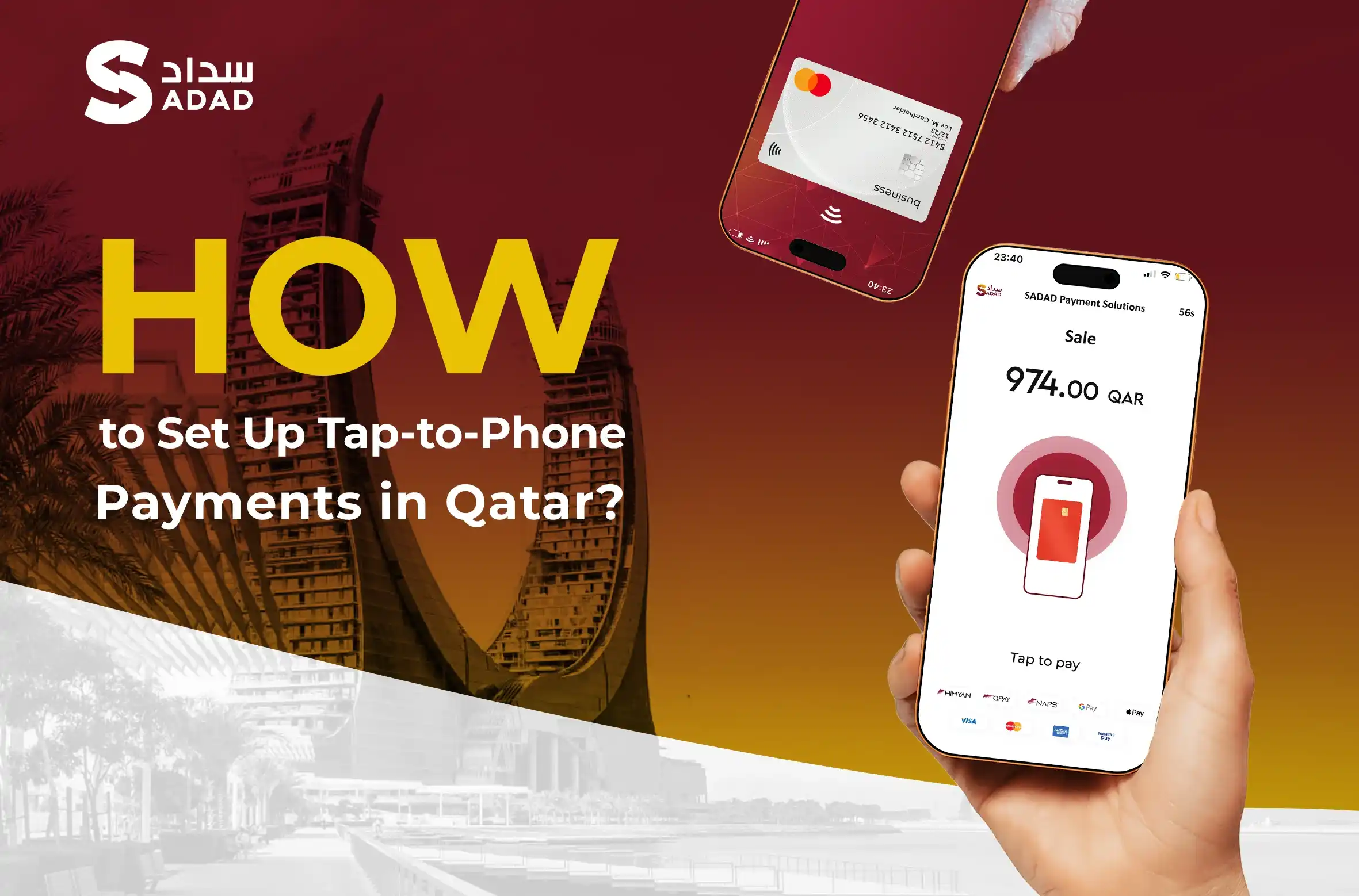
Understanding what tap-to-phone is takes about two minutes. Getting set up takes a few hours. Here’s exactly what it requires.
Check your device first.
Most modern Android phones have NFC built in. For Apple, any iPhone XS or later works as a tap-to-phone terminal. To confirm NFC on Android: Settings > Connections > NFC. If it’s listed, you’re ready.
SADAD’s SoftPOS runs on Android. If your team is on Android, you can be live the same day you sign up.
| Requirement | Details |
| Device | NFC-enabled Android smartphone |
| Software | SADAD SoftPOS app (free download) |
| Account | Active SADAD merchant account |
| Internet | Active mobile data or Wi-Fi connection |
| Hardware | Nothing else |
That last row is the one that matters. No terminal delivery. No installation appointment. No QAR 500 upfront investment in hardware that might not arrive for two weeks.
The actual setup:
- Create your SADAD merchant account
- Download the SoftPOS app
- Log in and run a test transaction
- Start accepting payments
SADAD activates merchant accounts without a branch visit. From signup to first live payment, you’re looking at hours, not weeks.
That’s a meaningful difference if you’re a home-based business trying to take your first card payment this week, or a café that needs a backup terminal before the weekend rush.
One practical note: assign the app to the phone your staff uses most at the counter or in the field.
You can run multiple payment channels through a single SADAD dashboard, so SoftPOS transactions appear alongside your online and invoice payments in a single reconciliation view.
With a setup this simple, the more interesting question is how deeply this technology has already taken hold across Qatar.
Tap-to-Phone in Qatar Is Not a Pilot Program Anymore
This is the part most explainer articles skip. They tell you what tap-to-phone is without telling you how deeply it’s already embedded in Qatar’s actual commerce.
So here’s the real picture.
Since Visa launched Tap to Phone in Qatar, transaction volumes have grown fivefold, and transaction counts sixfold. The solution now covers over 5,000 merchant locations, including Karwa Taxis, DHL, and Hi Wash.
These aren’t trendy fintechs experimenting with new tech. Karwa Taxis is how most of Qatar moves. DHL is a logistics infrastructure. That’s tap-to-phone running in the backbone of daily life.
Visa recognized QNB for recording the highest growth in Tap to Phone volume and transactions in Qatar in 2023, and QNB followed that by achieving the highest growth in mobile payment transactions among SMEs and small merchants in 2024 as well. Two consecutive years at the top.
That’s not luck. That’s a market actively choosing this technology.
Here’s where it stands today across the main providers:
| Provider | Solution | Target |
| QNB + Visa | Tap to Phone | SMEs, micro-merchants |
| QNB + Mastercard | myPOS | Small businesses, Android |
| SADAD | SoftPOS | SMEs, freelancers, mobile businesses |
The difference with SADAD is worth understanding. QNB’s solutions are bank-issued, meaning they sit within a banking relationship. SADAD’s SoftPOS connects directly to a full payment stack: online gateway, invoice links, real-time dashboard, and in-person mobile acceptance, all in one account.
For a small business in Qatar that sells through WhatsApp, accepts walk-ins, and wants one place to reconcile everything, that’s not a minor convenience. It’s the whole setup.
But to understand why Qatar adopted this faster than almost anywhere else, you have to go back to 2022.
Qatar’s Contactless Habit Was Built Before Tap-to-Phone Existed
The adoption numbers make sense when you understand the foundation underneath them.
For the FIFA World Cup, Visa installed 5,300 contactless-enabled payment terminals across all official venues, making it the most payment-enabled FIFA tournament in history. Over one million international visitors arrived expecting to tap.
Qatar’s merchants had to be ready, and most of them got there fast. 89% of all Visa transactions at FIFA venues ended up being contactless.
Here’s the part most people miss: that infrastructure didn’t disappear after the final whistle.
Post-tournament, contactless terminal density expanded to cover virtually all fuel, grocery, and pharmacy chains. By April 2025, contactless accounted for 92% of card purchases at supermarkets. Qatar’s consumers didn’t go back to swiping.
They kept tapping, and businesses that weren’t set up to receive that tap started losing sales quietly.
That’s the market your business is operating in right now.
| Metric | Figure |
| FIFA 2022 contactless terminals deployed | 5,300+ |
| Contactless share of FIFA venue payments | 89% |
| Contactless share of supermarket card payments (April 2025) | 92% |
| Qatari merchants who consider digital acceptance essential | 86% |
The consumer habit is already formed. The infrastructure is already in place. Tap-to-phone doesn’t ask Qatar’s market to change its behavior.
It just makes it cheaper for your business to participate in behavior that’s already happening at scale.
Which brings up the next question every merchant asks: Is my phone actually a safe place to process someone’s card payment?
Is Tap-to-Phone Actually Secure?
It’s a fair question. And the answer is more rigorous than most people expect.
Every tap-to-phone transaction uses encryption. The card data is exchanged as a single-use token through the payment network, never the actual card number.
That token is mathematically useless after the transaction completes. Even if someone intercepted the signal, there’s nothing to reuse.
The underlying standard that governs all of this is PCI MPoC, the Payment Card Industry’s Mobile Payments on Commercial Off-the-Shelf framework. All tap-to-phone solutions must comply with PCI MPoC standards, and transactions run through the same switching infrastructure as traditional POS terminals.
The phone is different. The security pipeline underneath it is identical.
| Security layer | What it does |
| Tokenization | Replaces card number with a one-time encrypted code |
| NFC range | Physically limited to 2-3cm — remote interception is impossible |
| PCI MPoC compliance | Global standard for all certified SoftPOS apps |
| Device attestation | Verifies the phone hasn’t been tampered with before processing |
| Biometric lock | Applies when a customer pays via Apple Pay or Google Pay |
SADAD’s SoftPOS is built on the same certified infrastructure, with PCI DSS and ISO 27001 certifications on top.
You can review SADAD’s security and compliance standards directly if you want the specifics before signing up.
The security question is settled at the infrastructure level. The more practical question is whether a phone actually replaces a traditional terminal for your specific business, or whether you need both.
Tap-to-Phone vs Traditional POS: How to Pick the Right One for Your Business
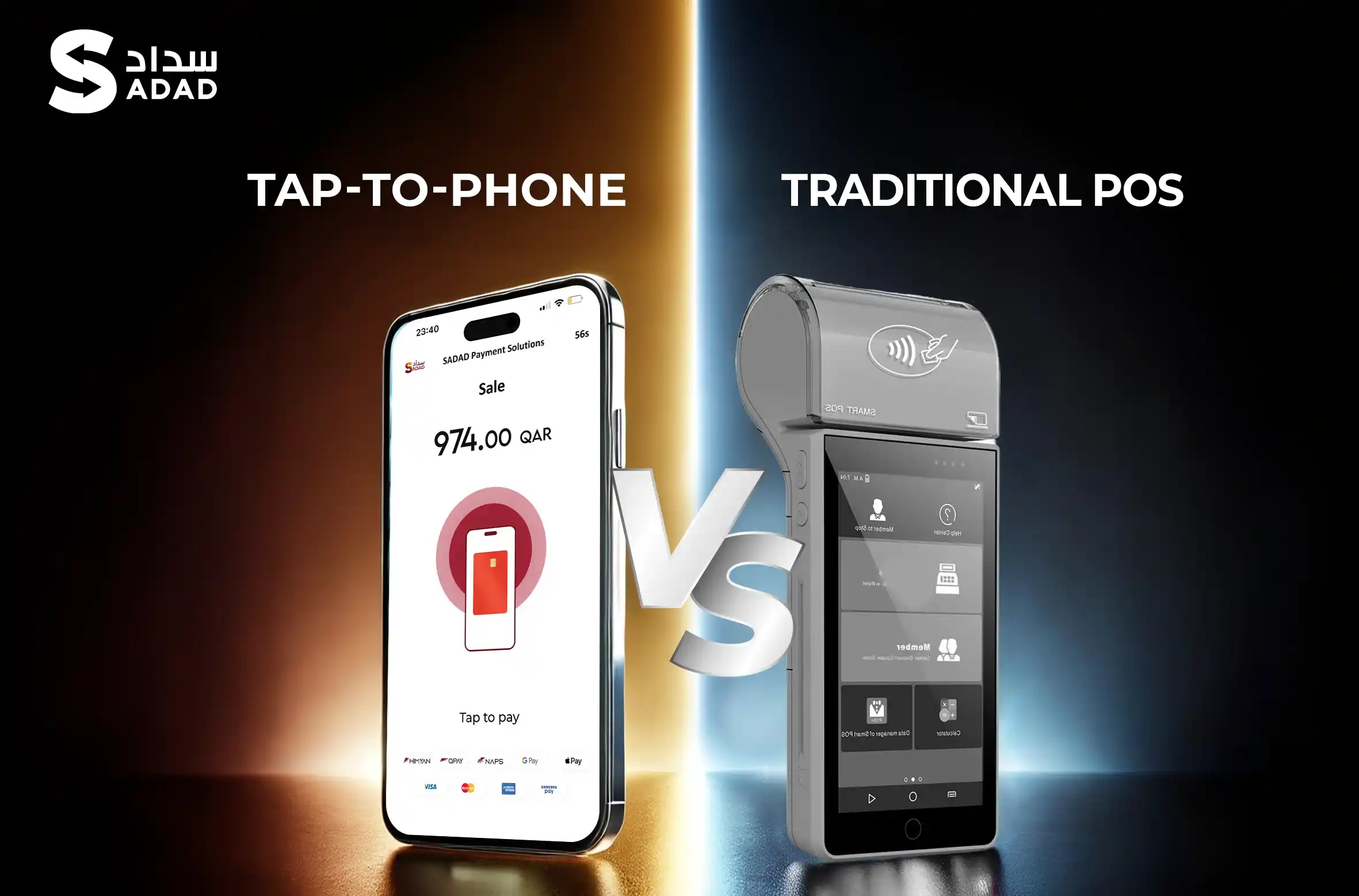
Most guides frame this as a binary choice. It isn’t.
The smarter frame is: which tool best matches how money actually moves in your business day-to-day?
71% of merchants globally expect SoftPOS to replace traditional terminals over time. That doesn’t mean it has replaced them yet, or that it’s the right primary setup for every business today.
| Factor | Tap-to-Phone (SoftPOS) | Traditional POS |
| Hardware cost | Zero | QAR 500 to 2,000+ |
| Setup time | Hours | Days to weeks |
| Mobility | Fully mobile | Fixed unless you buy a portable unit |
| Receipt printing | Digital only (SMS/email) | Printed or digital |
| High-volume fixed retail | Limited | Built for it |
| Inventory management | Depends on provider | Built in on most systems |
| Best for | Mobile, delivery, pop-ups, backup | Restaurants, retail counters, clinics |
Most businesses shouldn’t choose one. They should use both.
A café in West Bay runs a fixed SADAD Plus terminal at the counter for the lunch rush, and has SoftPOS on staff phones for tableside payments and overflow. One dashboard. One reconciliation.
No separate provider to call when something breaks.
If you’re still running only a bank-issued terminal that requires a branch visit to update, you’re already behind.
Choosing the right POS setup in Qatar depends on your transaction volume, your physical setup, and whether your customers come to you or you go to them.
With the tool selection clear, what most merchants want to know next is how much this actually costs to run.
How Much Does Tap-to-Phone Actually Cost in Qatar?
The cost structure here is simpler than most merchants expect.
- Hardware cost: zero. Tap-to-phone runs on a phone you already own. No terminal purchase, no rental fee, no delivery charge.
- Transaction fees: this is where you pay. Like any card acceptance method, tap-to-phone carries a per-transaction fee shaped by Qatar Central Bank’s MDR framework.
QCB reduced and unified the Merchant Discount Rate for debit card payments: 0.5% for micro-enterprises and gas stations, capped at QAR 50 per transaction, and 1.1% for other businesses, capped at QAR 110.
That cap matters more than most merchants realize. On a QAR 2,000 sale, you’re paying at most QAR 22 under the standard rate. That’s a fixed ceiling, not an open-ended percentage that compounds against you.
| Cost type | Tap-to-Phone | Traditional POS terminal |
| Hardware purchase | QAR 0 | QAR 500 to 2,000+ |
| Setup fee | QAR 0 | Varies by bank |
| Monthly rental | QAR 0 | Varies |
| Transaction fee (debit, micro) | 0.5%, max QAR 50 | 0.5%, max QAR 50 |
| Transaction fee (debit, standard) | 1.1%, max QAR 110 | 1.1%, max QAR 110 |
| Maintenance | QAR 0 | Ongoing |
The transaction fees are identical. The difference is everything before you process your first payment.
For a business doing QAR 30,000 a month in card sales, the MDR cost is the same whether you’re using a phone or a terminal. But with tap-to-phone, you’ve saved the hardware cost on day one and removed the maintenance risk entirely.
For SADAD’s specific pricing, you can check sadad.qa/en/pricing directly.
The economic case is clear. What makes it even stronger is understanding the direction Qatar’s entire payments market is moving.
Qatar’s Retail Payments Are Shifting Fast. Here Is What That Means for Your Business Today.
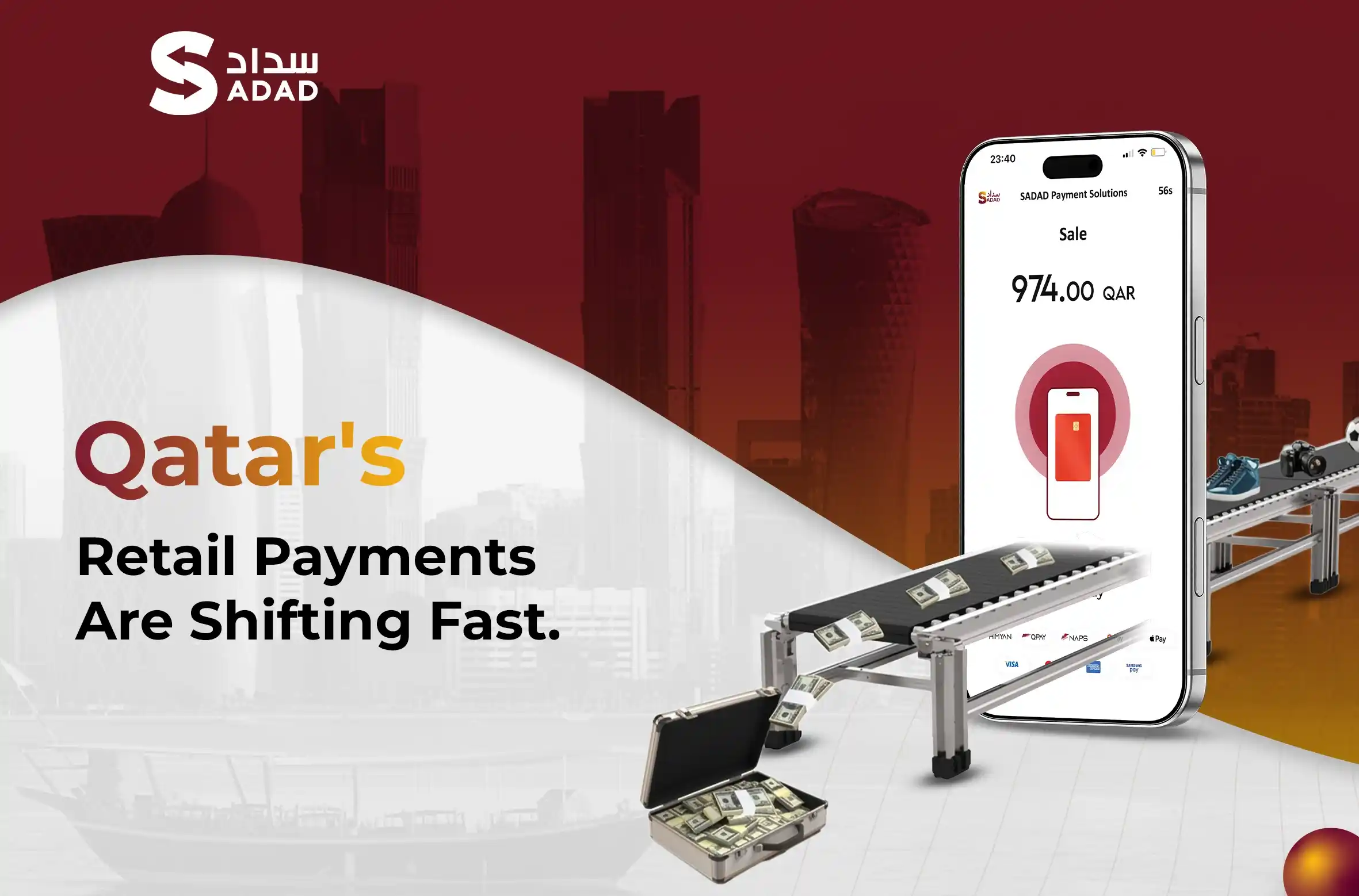
Qatar’s payments market is forecast to reach USD 14.54 billion by 2031, growing at a CAGR of 12.84%.
That’s the market doubling in six years. And the growth isn’t coming from more plastic cards. Digital wallet transactions are projected to grow at a 24.12% CAGR through 2030, the fastest among payment modes in the country.
In-store POS is still dominant today. But the gap with mobile commerce is closing every year.
Consumer behavior in Qatar is shifting toward expecting payment acceptance everywhere, not just at a checkout counter. Delivery drivers, home service providers, pop-up vendors at Katara, freelancers invoicing on WhatsApp.
The global SoftPOS market is growing at 23.1% CAGR and is projected to reach USD 1.24 billion by 2030, driven almost entirely by businesses that can’t afford to miss a sale because they don’t have a terminal on them.
Qatar isn’t an outlier in this. It’s ahead of it.
Most merchants treat tap-to-phone as a nice-to-have backup. The smarter framing is infrastructure. A business that can accept payment at any touchpoint, counter, tableside, delivery doorstep, event booth, captures revenue that a fixed-terminal business simply loses.
Subsidized QR-terminal rollouts and SoftPOS pilots on Android devices are making acceptance hardware-light across Qatar.
The direction QCB is pushing is clear. The question is whether your business is positioned to move with it or catch up later.
If you’re ready to act on what this section just laid out, the next step is straightforward.
Start Accepting Tap-to-Phone Payments in Qatar Today
The consumer habit is formed. The infrastructure is in place. The regulatory environment is actively pushing costs down. All that’s left is your business getting set up to receive it.
SADAD’s SoftPOS is the fastest path to tap-to-phone acceptance in Qatar. No hardware. No branch visit. No waiting. Download the app, activate your account, and start accepting Visa, Mastercard, NAPS, Apple Pay, and Google Pay from the phone you already own.
And if your business grows past a phone, SADAD scales with it. In-store POS terminals, online payment gateway, invoice links, and SoftPOS, all in one dashboard, one settlement, one support team.
Qatar’s payment infrastructure is moving fast. The businesses that win the next five years are the ones already set up to capture every transaction, everywhere.
Last Articles
Articles
Your Phone Is a POS Terminal Now: The Complete Guide to Tap-to-Phone Payments in Qatar
Tap-to-Phone Payments in Qatar: Turn Your Phone Into a POS Terminal and Start Getting Paid Today Your customers are already tapping to pay. The real question is whether your business...
Read more
Articles
The Qatar Business Owner’s Guide to WhatsApp Commerce and Getting Paid Faster
WhatsApp Commerce in Qatar: How to Turn Conversations into Sales with Payment Links You have already made sales on WhatsApp without calling them sales. A customer messages you asking about...
Read more
Articles
SADAD 360: The All-in-One Business Suite Built for Qatar’s SMEs
SADAD 360: The All-in-One Business Suite Built for Qatar's SMEs Most businesses in Qatar aren't struggling because of bad products or poor service. They're struggling because they're running their operations...
Read more